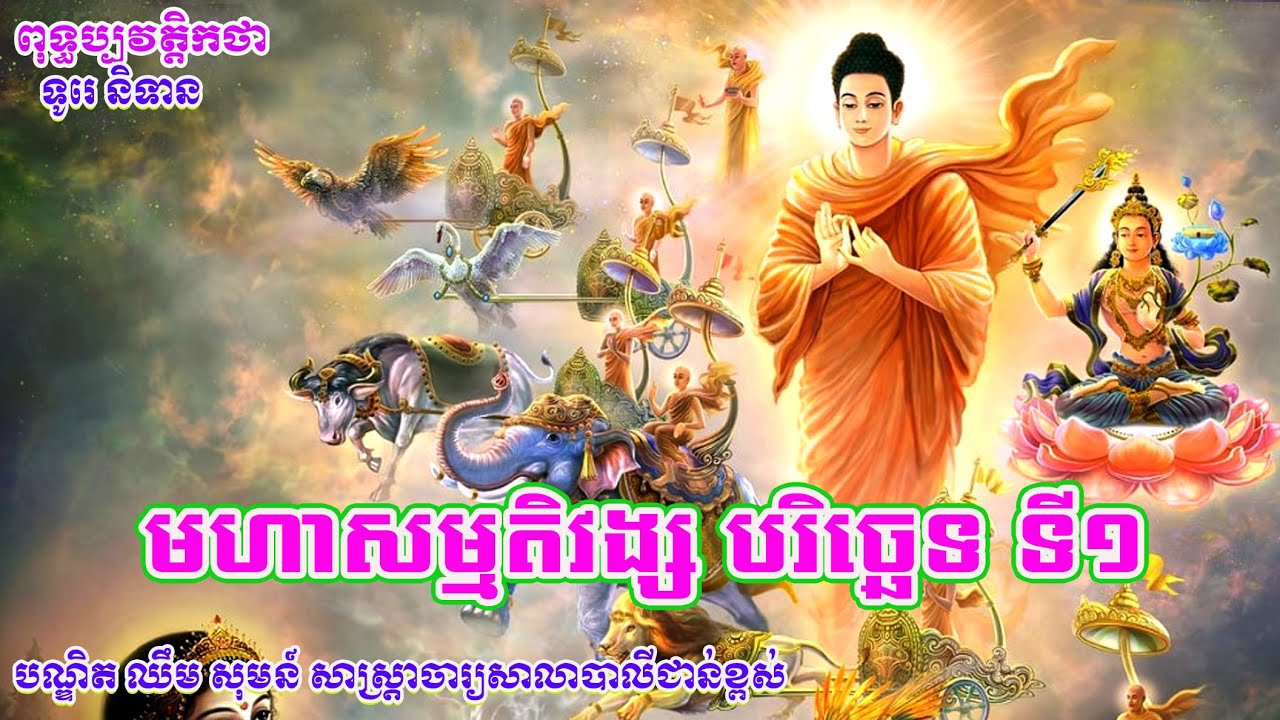
Chapter 1: The Lineage of Mahāsammata
In the beginning of this Bhaddakappa, our Bodhisatta was born as a king named Mahāsammata, the first monarch, who reigned over the entire continent of Jambudīpa. He had a royal son named Rojā, and King Rojā had a royal son named Vararojā. And King Vararojā had a royal son named Kalyāṇa. And King Kalyāṇa had a royal son named Varakalyāṇa. And King Varakalyāṇa had a royal son named Mandhātu. And King Mandhātu had a royal son named Sakka Mandhātu[1]. And King Sakka Mandhātu had a royal son named Uposatha. And King Uposatha had a royal son named Vararāja. And King Vararāja had a royal son named Upavararāja. And King Upavararāja had a royal son named Makhādeva, who continued to reign in succession.
From that time, the royal dynasty continued in succession for another 84,000 kings, until the time of the three kings of the Okkāka dynasty: King Pathama-Okkāka, King Dutiya-Okkāka, and King Tatiya-Okkāka. This King Tatiya-Okkāka had five queens: Queen Hatthā, Queen Cittā, Queen Jantu, Queen Jālinī, and Queen Visākhā.
Queen Hatthā, the chief queen, had four royal sons: Prince Okkākamukha, Prince Karaṇḍa, Prince Hatthinika, and Prince Nipura. She also had five royal daughters: Princess Piyā, Princess Suppiyā, Princess Ānandā, Princess Vijitā, and Princess Vijitasenā, making a total of nine royal children.
In later times, Queen Hatthā, the chief queen consort, passed away. The king then elevated his second wife to the position of chief queen. This new chief queen gave birth to a royal son. When the prince was five months old, she brought him before the king. The king felt great affection for the child and declared, “I grant you a boon. Whatever you desire, may it be fulfilled.” The chief queen replied, “Your Majesty, I desire only that the kingdom be given to this son. Please grant my wish.”
The king was dismayed, his heart torn, and he could not find a way out of his predicament. He then summoned his four elder sons, and after they had assembled, he said, “O my sons! Your father has made a rash promise to the chief queen. Therefore, you must all help me consider, what should your father do?”
The four princes prostrated themselves and replied, “It would not be proper for our royal father to break his word.”
The king said, “If that is so, then you must all go into the forest for a time. Take whatever you wish, except for the royal regalia.”
The four princes, led by Okkākamukha, paid their respects and bade farewell to their royal father and the royal family. With great sorrow and lamentation, they departed from the royal city, accompanied by their five sisters and a large following of men and women. The procession stretched for a distance of three yojanas, and still, the retinue was not at its end.
The royal princes and princesses conferred amongst themselves, saying, “Our retinue of soldiers is vast. We could easily wage war and conquer the kingdom of any vassal king. But what is the use in harming others? Therefore, we should go and live in the Himavanta forest.” And so they made their way towards the Himavanta, seeking a suitable place to build a new kingdom.
At that time, our Bodhisatta was born into a great Brahmin family and was named Kapila. He had renounced his wealth to go forth and live as an ascetic in a hermitage in the depths of the Himavanta forest. This ascetic Kapila was highly skilled in the science of discerning the qualities of the land.
He knew the auspicious and inauspicious qualities of every place. He saw that this particular tract of land was a place of great victory, for if any fierce animal, such as a lion or tiger, chased its prey there, or if a cat chased a mouse, or a snake chased a frog, upon reaching that spot, the powerless creature could turn and threaten the powerful one, causing the predator to retreat to another place.
When the royal princes, led by Okkākamukha, were searching for a place to build their city, the ascetic Kapila offered his hermitage grounds to the princes. The royals, along with their army, began to construct a city, and they named it “Kapilavatthu-puri” (The City of Kapila’s Ground) because it was the site of the ascetic Kapila’s hermitage.
From that time on, the eight ministers whom the great King Okkāka had sent as royal guardians to oversee the welfare of the princes and princesses, conferred amongst themselves, saying, “The royal princes and princesses have all come of age. We should arrange for their royal consecration.” They then went to the princes and princesses to propose this matter.
It was decided that the eldest sister should be established in the position of their mother. The four royal princes were then consecrated in marriage with the four younger royal princesses, in order of age, so as to prevent the mixing of their lineage with the blood of those who were not of pure descent. This royal lineage was given the name “Sakyavamsa” (the Sakya Dynasty).
They reigned in succession for many generations of kings, down to King Sivirāja, King Sañjaya, and King Vessantara. During the Sivirāja dynasty, the name of the city of Kapilavatthu was changed to Jetuttara. After King Vessantara passed away, his royal son named Jāli, who had been consecrated in marriage with his younger sister, Princess Kaṇhājinā, reigned in succession. He had a royal son named Sivivāhana. King Sivivāhana had a royal son named Sīhasara. The dynasty continued for 161,000 more kings until the reign of King Jayasena.
King Jayasena had a son named Sīhahanu, who was consecrated in marriage with the chief queen named Princess Kancanā, the younger sister of King Anjana of the city of Devadaha. He then changed the name of the city back to Kapilavatthu. King Sīhahanu had three sons[2]: Suddhodana, Sukkodana, and Amitodana, and two daughters: Amitā and Pamitā.
As for Princess Yasodharā, the daughter of King Jayasena, she became the queen of King Anjana. They had two daughters namely Princess Māyā and Princess Pajāpatī, and two sons, Suppabuddha and Daṇḍapāṇi.
(End of Chapter 1: The Lineage of Mahāsammata)
[1] This King Sakka Mandhātu is identified in the commentary to the Dhammapada as being the Bodhisatta himself, who lived for 36 reigns of the god Indra.
[2] According to the Pathamasambodhi, there were three sons; some versions of the Buddhappavatti say there were five, adding Dhotodana and Ghanitodana. The Buddhappavatti by the Supreme Patriarch of Thailand explains that Dhotodana and Ghanitodana are not prominent in the narratives, which is why some versions state that King Sīhahanu had only three sons.