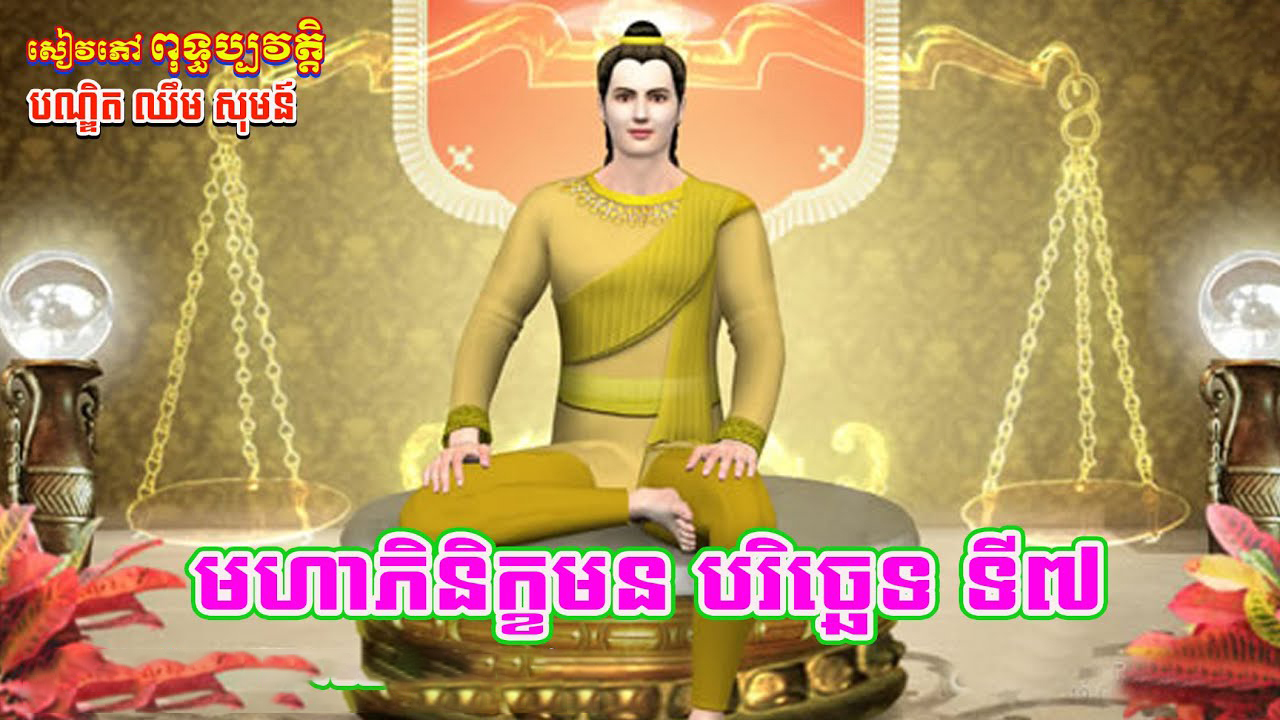
Chapter 7: The Great Renunciation
(1) One day, in the time that followed, the Bodhisatta felt a desire to go to the park to enjoy the park. He ordered the royal charioteer to ready the royal chariot, hitching two pairs of auspicious Sindh horses. The Great Being ascended and sat upon the royal chariot, surrounded by an entourage of servants and ministers, and proceeded to the park. At that moment, a Suddhāvāsa deity manifested as a very old man walking before them. The Bodhisattva and the charioteer saw him clearly. The Bodhisattva asked, and the charioteer prostrated and explained everything. The Prince, feeling a sense of spiritual urgency, ordered the charioteer to turn the royal chariot back.
(2) Another day, some time later, the Prince went out again and encountered a person afflicted with a disease, sick and writhing in pain. On his third excursion, he encountered a dead person. The Prince inquired, and the charioteer explained everything. Filled with spiritual urgency, he returned once more. On his fourth excursion, the future Buddha encountered a person who had adopted the life of an ascetic. He questioned the charioteer who then explained the ascetic’s way of life. The charioteer’s explanation of the four divine messengers was inspired by the power of the Suddhāvāsa deities. The future Buddha listened and felt his heart fill with joy for the ascetic life. He then proceeded to enjoy the park. Upon arriving, he descended to bathe in the auspicious royal lotus pond. Afterward, he ascended and sat upon a stone slab. Feeling the wish to be adorned, the god Viśvakarman disguised himself as a royal hairdresser and came to attend upon him. The Bodhisattva’s excursions to the park took place over a period of four months, as our Lord Buddha was still of a young age.
(3) At that moment, Princess Bimbā gave birth to a royal son, the child Rāhula. King Suddhodana sent a minister to convey the news to the Bodhisattva. When the minister bowed and delivered the royal message, the Prince uttered the words: “Rāhula has been born, a great bond has arisen.” Then he ascended the royal chariot and upon returning to the royal palace, he heard a verse spoken by a young noblewoman named Kisā Gotamī:
“Nibbutā nūna sā mātā, nibbuto nūna so pitā,
Nibbutā nūna sā nārī, yassāyaṃ īdiso pati.”
This means: “Truly peaceful is the mother, truly peaceful is the father of such a son as Prince Siddhartha. Truly peaceful is the wife who has such a husband.”
Upon hearing this, the Bodhisattva’s heart was filled with joy. He removed a pearl necklace from his neck and sent it as a gift to the noblewoman.
(4) The Great Being ascended to the palace and, after his meal, entered his royal bedchamber to rest through the first watch of the night.
The female musicians, who had been playing instrumental music, stopped their performance and fell asleep. They lay in disarray, some with their bodies exposed. When the Prince awoke in the middle watch of the night, he saw the unseemly state of the sleeping musicians and was filled with a sense of spiritual urgency, for the palace appeared to him as if it were strewn with corpses. He then awoke his minister Channa and told him to bring the noble steed Kanthaka. The Prince entered the chamber where he wished to hold his royal son. He saw Princess Yasodharā Bimbā sleeping with her hand resting on the royal child. He came back out, thinking to himself, “I shall see my son’s face at a later time.” He descended from the palace and mounted the horse, which was 18 cubits in length. He had Channa hold on to its tail as he departed the royal palace. When he was outside the city, he turned to look back at it one last time. That place is now called the “Stupa of No Turning Back” (Anivattana Cetiya).
(5) At that moment, Māra, the evil one, knowing what was happening, descended from the celestial realm and stood in the air, trying to stop him, saying, “O Siddhartha! Do not go forth to ordain. In seven days, the treasure of a universal monarch will be yours.” The Bodhisattva replied, “I already know this, and I have no desire for it.” Māra then moved away.
The Great Being, accompanied by an entourage of deities, traveled past three kingdoms: Kapilavastu, Sāvatthī, and Vesālī. He journeyed a distance of thirty yojanas until he reached the Anomā River. He questioned the minister Channa about everything and then spurred his horse across to the other side, fearing his father would send men to follow him.
(6) Then the Bodhisattva dismounted from Kanthaka and sat upon a sandy bank. He then ordered Channa to take the horse and the royal adornments and return, so that he could report the news to his royal father. The minister Channa led the horse a short distance away, but the horse’s heart broke from sorrow, and it died. It was reborn in the Tāvatiṃsa heaven as the deity named Kanthaka. The Great Being wished to cut his hair. At that moment, a divine jeweled sword fell from the sky. He cut his hair, leaving it two finger-breadths long, and it curled to the right in a spiral. He then made a vow and threw his topknot into the air. The god Indra caught it in a jeweled casket and enshrined it in the Cūḷāmaṇi Cetiya in the Tāvatiṃsa heaven.
(7) The Bodhisattva then thought of the three robes of a monk. At that moment, the great Brahmā Ghaṭikāra brought the eight requisites: three robes, a bowl, a razor, a needle case, a belt, and a water strainer, and offered them to him. The Great Being accepted the requisites, took upon himself the banner of the Noble Ones, put on the three robes, and completed his own ordination. He then gave his pair of royal cloths to the great Brahmā. The great Brahmā Ghaṭikāra took them and enshrined them in the Dussa Cetiya, which is twelve yojanas high, in the Brahmā world.
The Bodhisattva, who went forth to ordain, was twenty-nine years old. He departed in the middle watch of the night on a Thursday, the full moon of the month of Āsāḷha, in the year of the Rabbit.
(End of the Chapter on the Great Renunciation, Chapter 7)